Control hierarchy
Rangorde
Directions from an authorised person take precedence; traffic lights, signs, markings and general rules follow in their legal order.
Priority and Right of Way · Voorrang en voor laten gaan
Learn a repeatable way to combine traffic lights, signs, markings, road type, direction and manoeuvre in real Dutch priority situations.
Clear English explanations • Dutch terminology included • 15 free questions, no account
Priority and Right of Way at a glance
Rule
Priority questions feel difficult when several road users arrive together. The solution is to read the scene in a fixed order: authorised directions first, then traffic lights, signs and markings, followed by the general rules and the manoeuvres being made.
The words also matter. Voorrang usually describes priority between drivers. Voor laten gaan is broader and appears when turning traffic, pedestrians, special manoeuvres or other duties require someone to go first.
Good exam reasoning identifies the rule and then checks whether a special factor changes it. A tram, an emergency vehicle, an exit construction or someone performing a special manoeuvre can alter an otherwise familiar answer.
Officer present
Follow the authorised direction first.
Controlled junction
Read lights, signs and markings before general rules.
Special manoeuvre
Expect a broad duty to give other traffic room.
Guidance
Rangorde
Directions from an authorised person take precedence; traffic lights, signs, markings and general rules follow in their legal order.
Gelijkwaardige kruising
When no sign, light, marking or construction changes priority, identify which drivers approach from the right.
Voorrangsweg
Recognise the signs and understand that the route's priority continues until it is ended or another control changes the situation.
Afslaand verkeer
A driver turning must account for traffic continuing on the same road, including cyclists and pedestrians where the rule applies.
Bijzondere manoeuvres
Moving off, reversing, changing lane, turning around or leaving an exit generally requires giving way to other traffic.
Bijzondere weggebruikers
Trams, pedestrians, priority vehicles and cyclists need their own rule check rather than an automatic assumption.
Guidance
A traffic officer's instruction overrides signs, lights and normal rules.
Confirm which signal applies to your lane or road user.
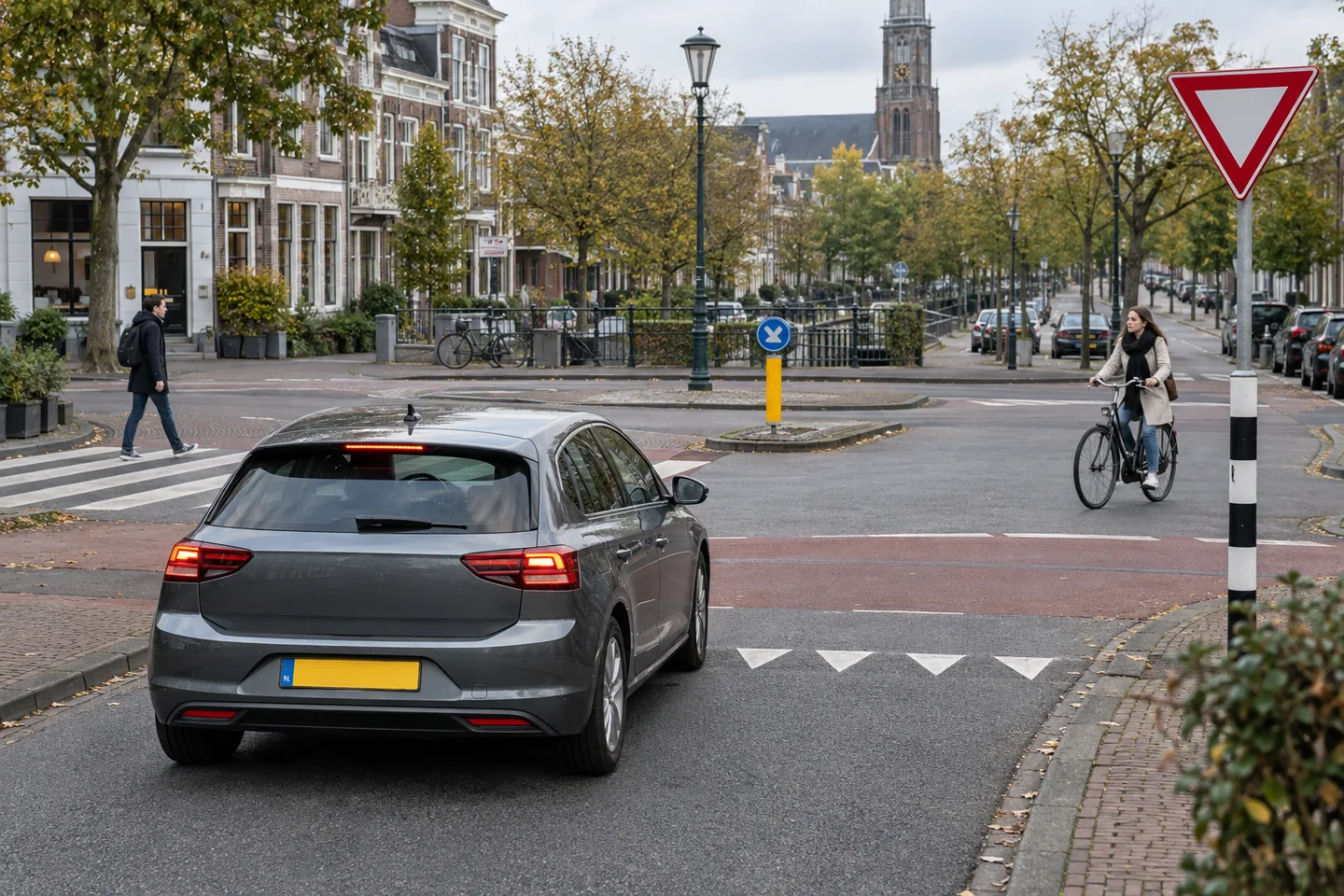
Check priority signs, stop lines and shark teeth for every approach.
An exit, raised pavement or unpaved road can change the relationship.
Separate straight-ahead traffic from turning or special manoeuvres.
Only then apply any tram, pedestrian or emergency-vehicle rule that matters.
Do not start with the vehicle closest to the junction. Start with the strongest legal instruction visible in the scene.
Vocabulary
Voorrang
Priority
Usually priority between drivers.
Voor laten gaan
Let go first
A broader duty that can include pedestrians.
Haaientanden
Shark teeth
Yield markings pointing towards the driver who must give way.
Voorrangsweg
Priority road
A road identified by the yellow diamond sign.
Gelijkwaardige kruising
Equal intersection
No control or construction makes one approach superior.
Bijzondere manoeuvre
Special manoeuvre
A movement that generally requires yielding to other traffic.
Warning
Why it's wrong: Visual prominence has no legal meaning; follow the hierarchy and movements.
Why it's wrong: Question images often reveal the answer through markings or signs on another approach.
Why it's wrong: That rule only becomes relevant after higher controls and road construction are checked.
Why it's wrong: A driver with priority can still have to yield when turning or performing a special manoeuvre.
Scenario
Scenario 01
You turn across a cycle path while a cyclist continues beside you on the same road.
Exam takeaway: Movement can change the answer even when you entered with priority.
Scenario 02
Two cars reach a junction with no lights or obvious priority signs.
Exam takeaway: Prove that the intersection is equal before using the rule for traffic from the right.
Scenario 03
Your signal shows green, but an authorised traffic officer signals you to stop.
Exam takeaway: The highest-ranking instruction decides.
Quick checkpoint
3 questions, answers revealed only after you submit.
Keep going
Stay current
CBRKlaar explains the rules in plain English. For the current legal text and government guidance, use these primary sources.
Answers
No. It is a general rule used only when stronger controls, road construction or a special rule do not decide the situation.
Voorrang commonly concerns priority between drivers; voor laten gaan is the wider duty to let another road user go first.
They require you to yield. You stop when necessary to give way safely.
Scan every approach, trace every path and explain the governing rule before looking at the answer choices.
You've learned the rules. Now test them in real CBR-style scenarios.