Road position
Plaats op de weg
Keep right where required, choose a stable line and position early for the route ahead.
Use of the Road · Gebruik van de weg
Understand lane discipline, following distance, overtaking, stopping and parking as one connected system of safe road use.
Clear English explanations • Dutch terminology included • 15 free questions, no account
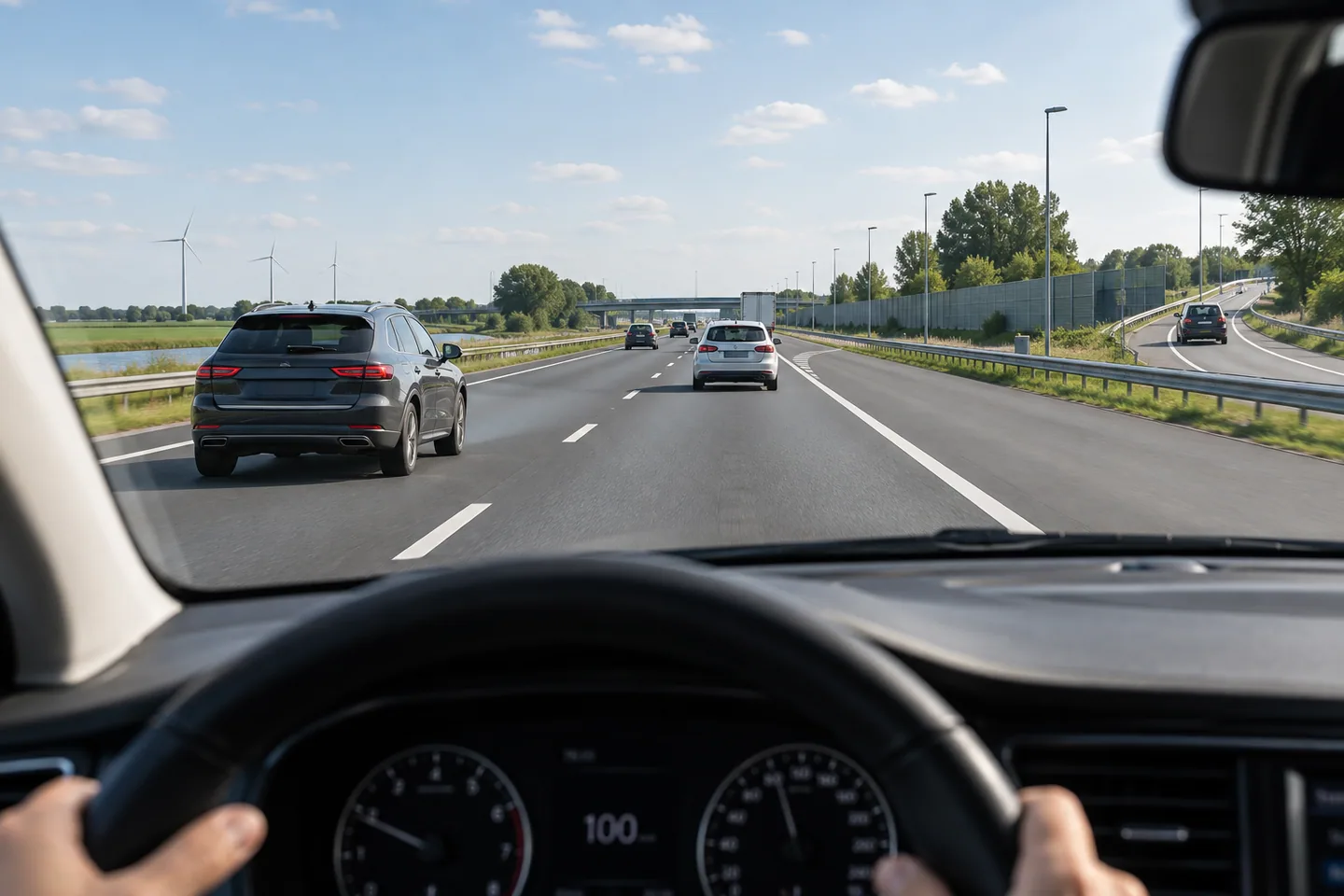
Use of the Road at a glance
Rule
This category covers the decisions that happen between junctions: where to position the vehicle, how much space to keep, which speed fits the conditions, when to overtake and where stopping or parking is permitted.
A posted maximum is not a target. The safe speed can be lower because of visibility, surface, traffic, weather or vulnerable users. The same principle applies to following distance and overtaking: legality is only the first test; safe execution is the second.
Questions often combine several rules. For example, an overtaking opportunity can be legal in theory but still unsafe because the view is limited or the speed difference is too small.
Normal travel
Choose a predictable position and preserve distance.
Changing lane
Mirror, signal, blind spot, then move when clear.
Limited visibility
Reduce speed before the hidden hazard appears.
Guidance
Plaats op de weg
Keep right where required, choose a stable line and position early for the route ahead.
Veilige snelheid
Stay within the limit while adapting to sight distance, weather, traffic and the possibility of stopping safely.
Volgafstand
Preserve enough time to observe, decide and brake without relying on the vehicle ahead.
Inhalen
Check legality, view, speed difference, oncoming traffic, mirrors, blind spot and a safe return gap.
Stilstaan
Distinguish a brief stop for immediate loading or passengers from parking, and recognise places where stopping itself is unsafe or prohibited.
Parkeren
Read signs, zones, markings and local restrictions, then leave the vehicle without creating danger or obstruction.
Guidance
Identify the lane layout, limit, markings and any temporary instruction.
Stay right or select the correct lane before the decision becomes abrupt.
Drive so the visible space and conditions leave room to stop safely.
Maintain following and side distance, especially around cyclists and large vehicles.
Overtaking, changing lane, stopping and parking each need a fresh legality and safety check.
The safest answer preserves options: space ahead, space beside you and time to change the plan.
Vocabulary
Rijstrook
Traffic lane
A marked part of the carriageway for a stream of traffic.
Volgafstand
Following distance
Space needed for perception, reaction and braking.
Inhalen
Overtaking
Passing another road user travelling in the same direction.
Stilstaan
Stopping
A limited halt for immediate traffic, passenger or loading needs.
Parkeren
Parking
Leaving the vehicle stopped beyond those immediate purposes.
Vluchtstrook
Emergency lane
Reserved for emergencies and authorised uses, not normal travel.
Warning
Why it's wrong: Conditions can require a substantially lower speed.
Why it's wrong: An overtake is not safe until there is a clear path out and back.
Why it's wrong: Reducing the buffer removes your own reaction and braking space.
Why it's wrong: The legal distinction depends on the immediate purpose, not simply on how long the vehicle remains still.
Scenario
Scenario 01
Traffic from an entrance lane must merge while your lane continues.
Exam takeaway: Use your position and speed to preserve a safe shared gap.
Scenario 02
The centre line and oncoming traffic leave little passing room.
Exam takeaway: Only overtake when the entire manoeuvre is safe.
Scenario 03
A space looks convenient but is close to a pedestrian crossing.
Exam takeaway: A space is not suitable merely because the car fits.
Quick checkpoint
3 questions, answers revealed only after you submit.
Keep going
Stay current
CBRKlaar explains the rules in plain English. For the current legal text and government guidance, use these primary sources.
Answers
No. It is a maximum; choose a lower speed when conditions, visibility or traffic require it.
A legal location, clear view, useful speed difference, enough side distance and a safe return gap.
It preserves the time needed to observe, react and brake when the situation ahead changes.
Look at the immediate purpose. A stop directly required by traffic or for immediate passenger/loading activity is treated differently from leaving the vehicle standing.
You've learned the rules. Now test them in real CBR-style scenarios.