Control hierarchy
Rangorde
Directions from authorised persons rank above traffic signs and general rules; read the current controlling instruction first.
Traffic Signs and Directions · Verkeerstekens en aanwijzingen
Learn the visual language of Dutch roads and the hierarchy that decides what to follow when several controls appear together.
Clear English explanations • Dutch terminology included • 15 free questions, no account
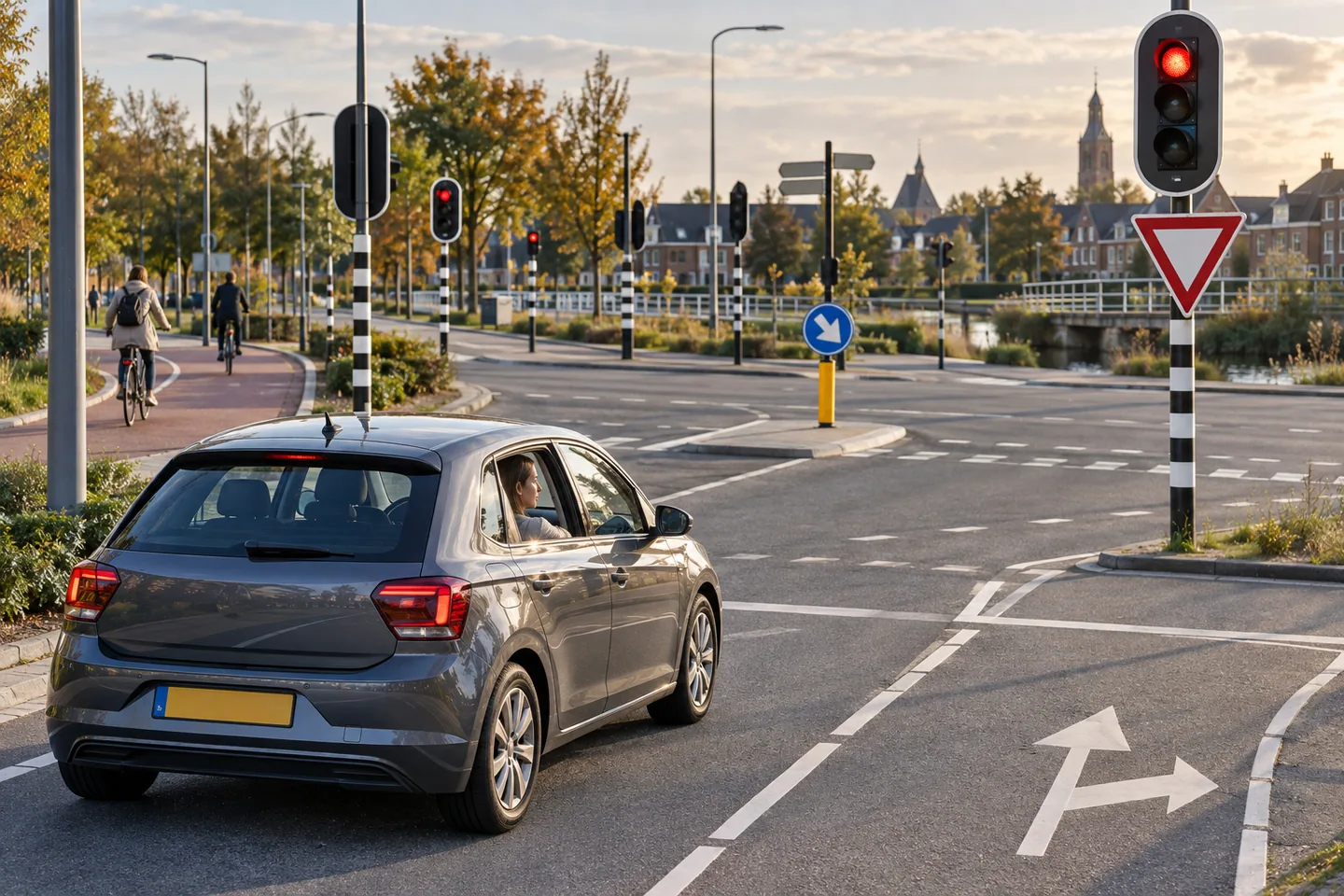
Traffic Signs and Directions at a glance
Rule
Traffic controls communicate through shape, colour, symbol, location and context. When you understand the family a sign belongs to, you can often predict its purpose before recalling every detail.
A question may contain a sign, a marking, a light and an authorised direction at the same time. The exam expects you to know which one takes precedence and which one still provides useful information for the next part of the road.
Temporary controls deserve the same disciplined reading. Roadworks can change lanes and routes, so follow the current instruction rather than the road pattern you remember.
Authorised direction
Follow it before lights, signs or normal rules.
Sign plus panel
Read both as one complete instruction.
Temporary layout
Slow down and follow the current controlled route.
Guidance
Rangorde
Directions from authorised persons rank above traffic signs and general rules; read the current controlling instruction first.
Bordcategorieën
Use shape, border, colour and symbol to distinguish warnings, prohibitions, mandatory directions and information.
Wegmarkeringen
Read lane lines, arrows, stop lines, shark teeth and coloured surfaces together with nearby signs.
Verkeerslichten
Identify which signal applies to your lane, direction or road-user type.
Aanwijzingen
Recognise signals from police, traffic controllers and other authorised persons and respond safely.
Tijdelijke verkeersmaatregelen
Expect altered lanes, reduced space and unusual priority around roadworks or incidents.
Guidance
Look for an authorised person before relying on lights, signs or normal rules.
Check lane, direction, road-user symbol, position and any supplementary panel.
Use shape and colour to establish warning, prohibition, command or information.
Markings and physical layout show where and how the instruction operates.
A new sign, end sign, junction or zone boundary can alter the instruction.
Verkeerstekens is broader than signs alone: it includes road signs, lights and markings used to control traffic.
Vocabulary
Verkeersteken
Traffic control or sign
A broad term covering signs, signals and markings.
Aanwijzing
Authorised direction
An instruction given by an authorised person.
Onderbord
Supplementary plate
Adds a condition, exception, distance or category to the main sign.
Stopstreep
Stop line
Shows where to stop for the relevant control.
Doorgetrokken streep
Solid line
A line whose meaning depends on position and context.
Zone
Zone
An instruction applying across an area until the zone ends.
Warning
Why it's wrong: The plate can change who, when or how far the instruction applies.
Why it's wrong: The authorised direction has the higher rank.
Why it's wrong: Shape, symbol, border and location work together; one visual clue can be misleading.
Why it's wrong: The rule can remain active across multiple streets until an end indication.
Scenario
Scenario 01
Your light is green but a police officer directs your lane to wait.
Exam takeaway: When controls conflict, follow the legal hierarchy.
Scenario 02
A restriction sign includes a supplementary plate with specified times.
Exam takeaway: Read the whole traffic control, not only the largest symbol.
Scenario 03
Temporary arrows and barriers guide traffic away from the usual route.
Exam takeaway: Follow the road as controlled now, not as remembered.
Quick checkpoint
3 questions, answers revealed only after you submit.
Keep going
Stay current
CBRKlaar explains the rules in plain English. For the current legal text and government guidance, use these primary sources.
Answers
It is broader than traffic signs and can include road markings and traffic signals used to regulate or guide traffic.
An authorised person's direction comes first. Then consider the applicable lights, signs, markings and general rules in their legal relationship.
Learn the core signs and families, then practise reading shape, colour, symbol, location and supplementary plates together.
Use the current RVV 1990 and its sign appendix, alongside current government guidance.
You've learned the rules. Now test them in real CBR-style scenarios.