Motorways and expressways
Autosnelweg en autoweg
Recognise entry and exit rules, lane use, prohibited users and the exceptional purpose of the emergency lane.
Special Roads, Road Users and Manoeuvres · Bijzondere wegen, weggebruikers en manoeuvres
Bring motorways, roundabouts, residential areas, cyclists, trams and special manoeuvres into one clear decision framework.
Clear English explanations • Dutch terminology included • 15 free questions, no account
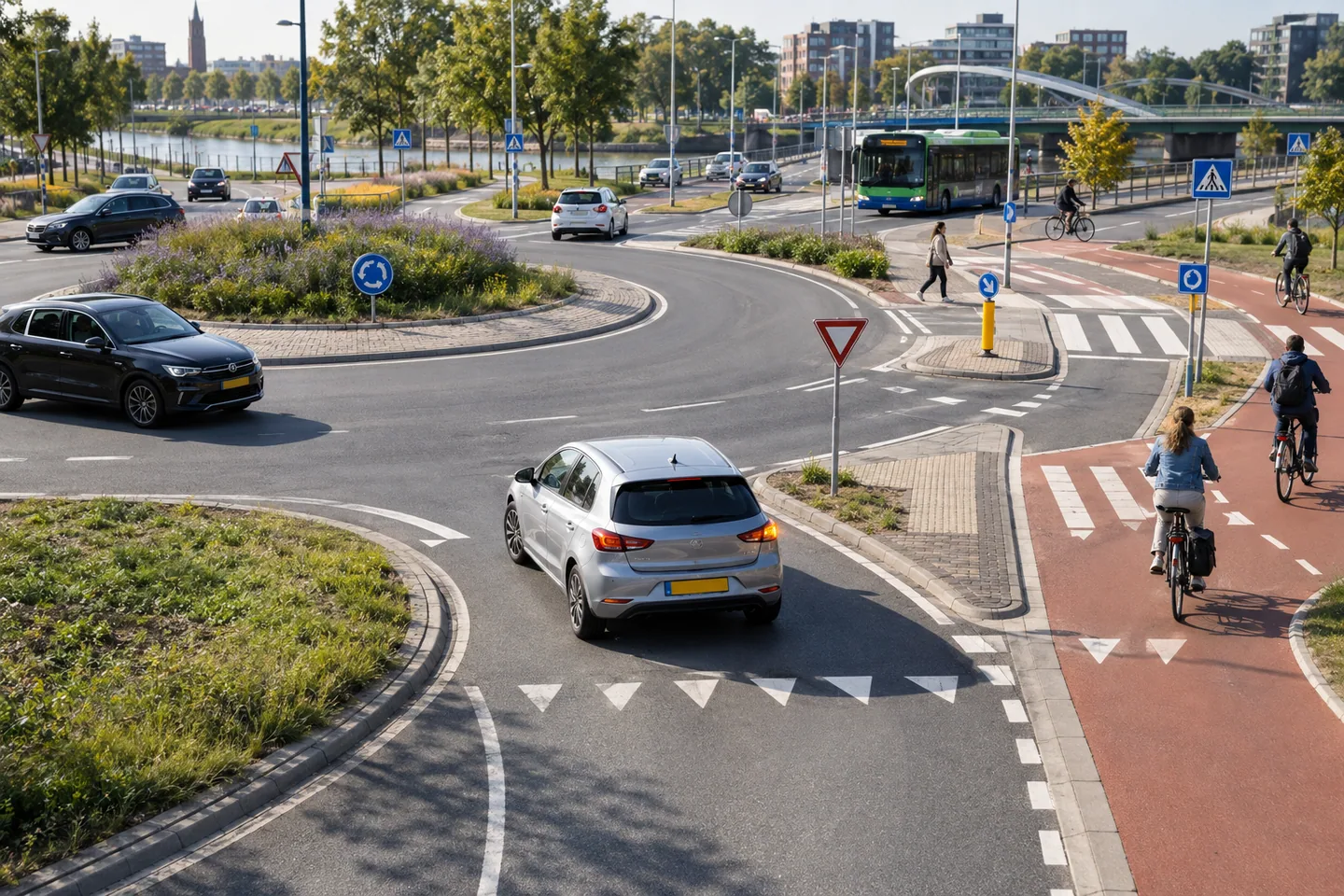
Special Roads, Road Users and Manoeuvres at a glance
Rule
Some roads have a special legal identity. Some road users need a different expectation. Some manoeuvres create an extra duty to give way. The category tests whether you recognise these signals before applying a familiar general rule.
The useful question is: what is special here? It may be the road—such as a motorway, living street or railway crossing; the road user—such as a tram, child or mobility scooter; or your own movement—such as reversing, changing lane or leaving an exit.
Images often contain several candidates. A reliable answer comes from naming the special factor, applying its consequence and then checking that the action remains safe for everyone else.
Special road
Identify the road status before applying a general rule.
Vulnerable user
Increase time, space and observation.
Special manoeuvre
Expect to yield broadly to other traffic.
Guidance
Autosnelweg en autoweg
Recognise entry and exit rules, lane use, prohibited users and the exceptional purpose of the emergency lane.
Rotondes
Read signs and markings at each approach and crossing rather than assuming every roundabout works identically.
Erf en zones
Adapt speed, position and expectations where people can use the whole street or zone rules continue across several roads.
Kwetsbare weggebruikers
Expect less protection, different speed and possible uncertainty from children, cyclists, pedestrians and people with disabilities.
Grote voertuigen en trams
Account for blind spots, wide turns, long braking distances and the fixed path of a tram.
Bijzondere manoeuvres
Recognise moving off, reversing, turning around, changing lane and entering from an exit as movements with a broad yielding duty.
Guidance
Identify motorway, expressway, residential zone, roundabout, crossing or another special section.
Look for cyclists, pedestrians, trams, buses, priority vehicles and large vehicles.
Decide whether you are simply following the road or performing a special manoeuvre.
Translate that factor into lane choice, priority, speed, observation or yielding.
Look for blind spots, a second cycle path, a pedestrian island or traffic emerging behind a large vehicle.
The category becomes manageable when you label the special factor before choosing the rule.
Vocabulary
Autosnelweg
Motorway
A road with motorway status and its own access and use rules.
Autoweg
Expressway
A different special road category, recognised by its sign.
Erf
Residential or living street
A shared environment where people may use more of the road space.
Dode hoek
Blind spot
An area a driver cannot see directly or in mirrors.
Bijzondere manoeuvre
Special manoeuvre
A movement carrying an extra duty to yield.
Overweg
Railway crossing
A crossing where rail traffic and warnings demand special caution.
Warning
Why it's wrong: The signs and shark teeth at that specific entry and cycle crossing decide.
Why it's wrong: A lane change is a special manoeuvre and requires a complete mirror and blind-spot check.
Why it's wrong: The blind spot and turning path can remove your escape space even when your lane continues.
Why it's wrong: A zone normally continues until an end-of-zone indication changes it.
Scenario
Scenario 01
You need to cross an outer lane and a cycle crossing to take your exit.
Exam takeaway: One intended exit can contain several separate yielding decisions.
Scenario 02
A truck ahead signals right while you are alongside on the cycle-side of the road.
Exam takeaway: Do not remain where another driver's geometry removes your safety margin.
Scenario 03
You reverse into a street where cyclists and cars continue behind you.
Exam takeaway: The person creating the unusual movement carries the extra responsibility.
Quick checkpoint
3 questions, answers revealed only after you submit.
Keep going
Stay current
CBRKlaar explains the rules in plain English. For the current legal text and government guidance, use these primary sources.
Answers
No. Signs and road markings at the entry and at cycle or pedestrian crossings determine the local situation.
Moving off, reversing, turning around, changing lanes, entering or leaving certain places and similar non-standard movements.
Their blind spots, braking distance and wide turning path create risks a car driver must anticipate.
For every image, identify the special road, the special user and the special manoeuvre before applying rules.
You've learned the rules. Now test them in real CBR-style scenarios.