Fitness to drive
Rijgeschiktheid
Judge honestly whether fatigue, illness, alcohol, drugs, medication or emotion makes driving unsafe.
Responsible Road Use and Environmentally Conscious Driving · Verantwoord en milieubewust rijden
Connect driver fitness, anticipation, courtesy and efficient vehicle use to the choices the Dutch theory exam expects.
Clear English explanations • Dutch terminology included • 15 free questions, no account
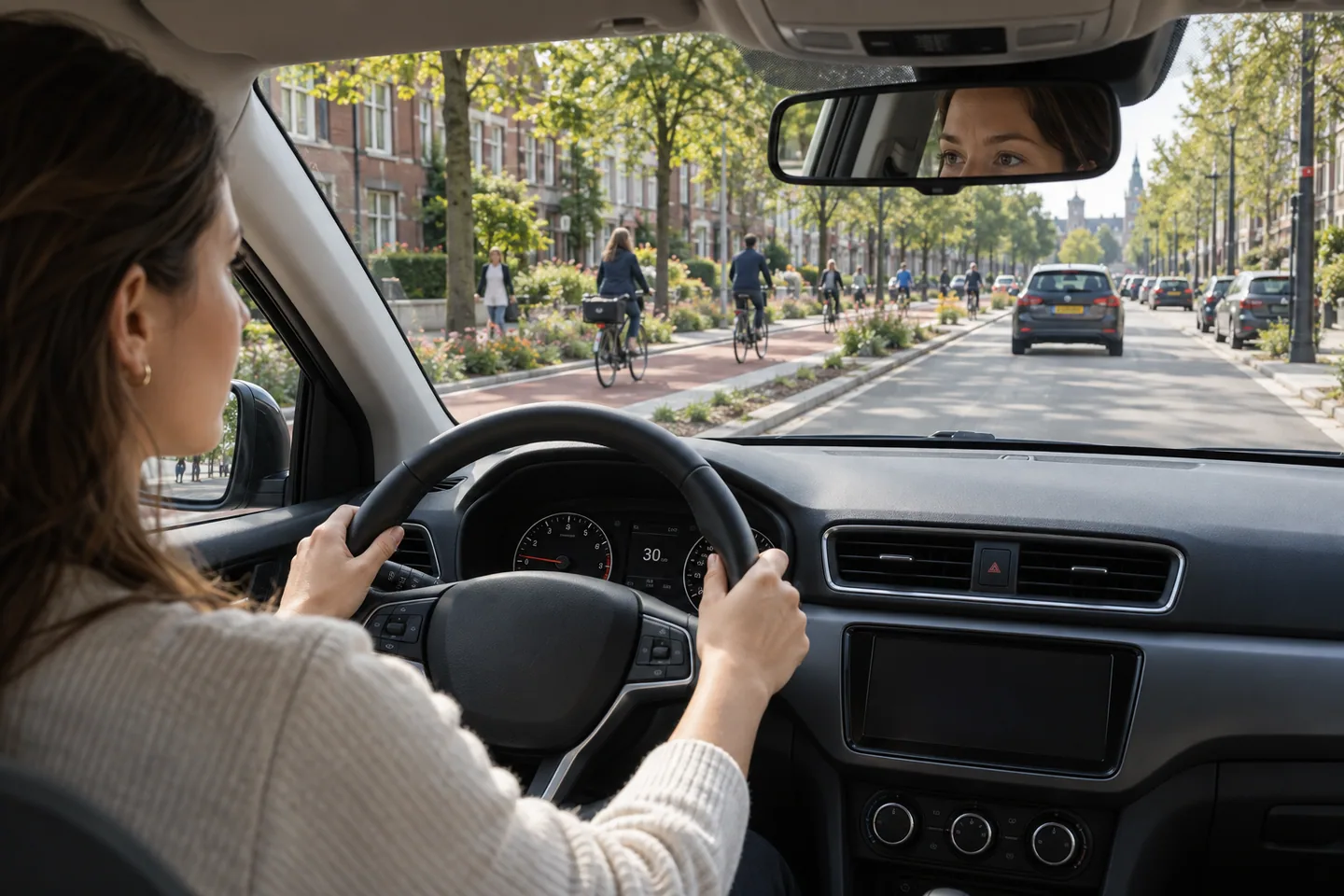
Responsible Road Use and Environmentally Conscious Driving at a glance
Rule
This category asks whether the driver can make safe, considerate choices rather than merely follow a sign. Fitness to drive, attention, emotions, fatigue, alcohol, medication and distraction all shape the risk you bring onto the road.
Environmentally conscious driving is closely connected to safety. Looking well ahead, maintaining space, accelerating smoothly and avoiding unnecessary speed changes reduce both consumption and sudden decisions.
The strongest exam answer is normally the one that creates a predictable situation, protects vulnerable road users and avoids transferring your urgency or mistake to somebody else.
Before driving
Confirm you are fit, focused and prepared.
Developing hazard
Release speed early and preserve options.
Pressure or emotion
Do not let urgency become another road user's risk.
Guidance
Rijgeschiktheid
Judge honestly whether fatigue, illness, alcohol, drugs, medication or emotion makes driving unsafe.
Anticiperen
Look far enough ahead to release the accelerator early, preserve space and avoid surprise braking.
Voorspelbaar rijgedrag
Signal in time, choose a stable position and make intentions understandable to other road users.
Milieubewust rijden
Use smooth acceleration, appropriate gears, steady speed and sensible journey planning to reduce wasted energy.
Sociaal rijgedrag
Allow for mistakes, avoid aggression and give vulnerable or uncertain road users the time they need.
Afleiding voorkomen
Set navigation and cabin controls before departure and keep attention on the developing traffic scene.
Guidance
Ask whether you are rested, sober, calm and medically fit to drive.
Use the wider scene to identify changing lights, crossings, queues and vulnerable users early.
Choose speed, distance and position that preserve time to respond.
Avoid unnecessary acceleration, harsh braking and needless engine use.
Communicate clearly and never force another road user to solve your decision.
Safe, social and efficient driving usually point to the same answer: anticipate early and act smoothly.
Vocabulary
Rijgeschiktheid
Fitness to drive
Your physical and mental ability to drive safely.
Anticiperen
Anticipate
Recognise likely developments before they become urgent.
Afleiding
Distraction
Anything that takes attention away from the driving task.
Volgafstand
Following distance
The space that preserves reaction and braking time.
Rijstijl
Driving style
The pattern of speed, control and decisions you use.
Stationair draaien
Idling
Running the engine while stationary without a driving need.
Warning
Why it's wrong: Fatigue reduces observation and reaction; motivation does not restore alertness.
Why it's wrong: Repeated acceleration and braking waste energy and reduce the safety margin.
Why it's wrong: The horn is a warning tool, not a way to pressure a slower road user.
Why it's wrong: Changing a route or setting a device divides attention at the moment you need it most.
Scenario
Scenario 01
Your concentration drops and you begin missing details.
Exam takeaway: Fitness to drive is a condition, not a promise to try harder.
Scenario 02
You see the signal change while still far from the queue.
Exam takeaway: Look ahead, then convert information into a smooth action.
Scenario 03
The cyclist's path is uncertain although you technically have room to continue.
Exam takeaway: A safety margin matters more than proving your priority.
Quick checkpoint
3 questions, answers revealed only after you submit.
Keep going
Stay current
CBRKlaar explains the rules in plain English. For the current legal text and government guidance, use these primary sources.
Answers
They overlap strongly: anticipation, steady speed and space reduce risk as well as unnecessary energy use.
Yes. Check the warning information and seek professional advice when you are unsure about driving safely.
It means being predictable, allowing for others' limitations and avoiding actions that pressure or endanger them.
Scan farther ahead and ask what could change in the next few seconds.
You've learned the rules. Now test them in real CBR-style scenarios.