Hazard recognition
Gevaarherkenning
Spot clues early, reduce speed and cover the brake before the situation becomes critical.
Drive Safely and Respond to Emergency Situations · Veilig rijden en handelen bij noodsituaties
Learn how safe observation, vehicle control and a clear emergency sequence turn an unexpected event into a manageable situation.
Clear English explanations • Dutch terminology included • 15 free questions, no account
Drive Safely and Respond to Emergency Situations at a glance
Rule
The exam does not expect heroic improvisation. It expects a safe order: keep control, reduce immediate danger, protect people, warn others and summon the right help.
Many emergencies begin as ordinary hazards—a queue beyond a bend, sudden poor visibility, a tyre problem or a driver who has not seen you. Scanning and space prevent some of these events from becoming emergencies at all.
When something does go wrong, the best action depends on location. A breakdown on a motorway, a minor collision in a quiet street and an injured person each demand a different response, but personal safety remains the first filter.
Immediate hazard
Keep control before changing direction.
Vehicle stopped
Move people away from live traffic where possible.
Scene secured
Warn others and call the right assistance.
Guidance
Gevaarherkenning
Spot clues early, reduce speed and cover the brake before the situation becomes critical.
Noodstop
Brake firmly while maintaining steering control and continue observing the escape space around you.
Gripverlies
Use smooth inputs, reduce the cause of instability and avoid sudden steering or braking that adds imbalance.
Pech
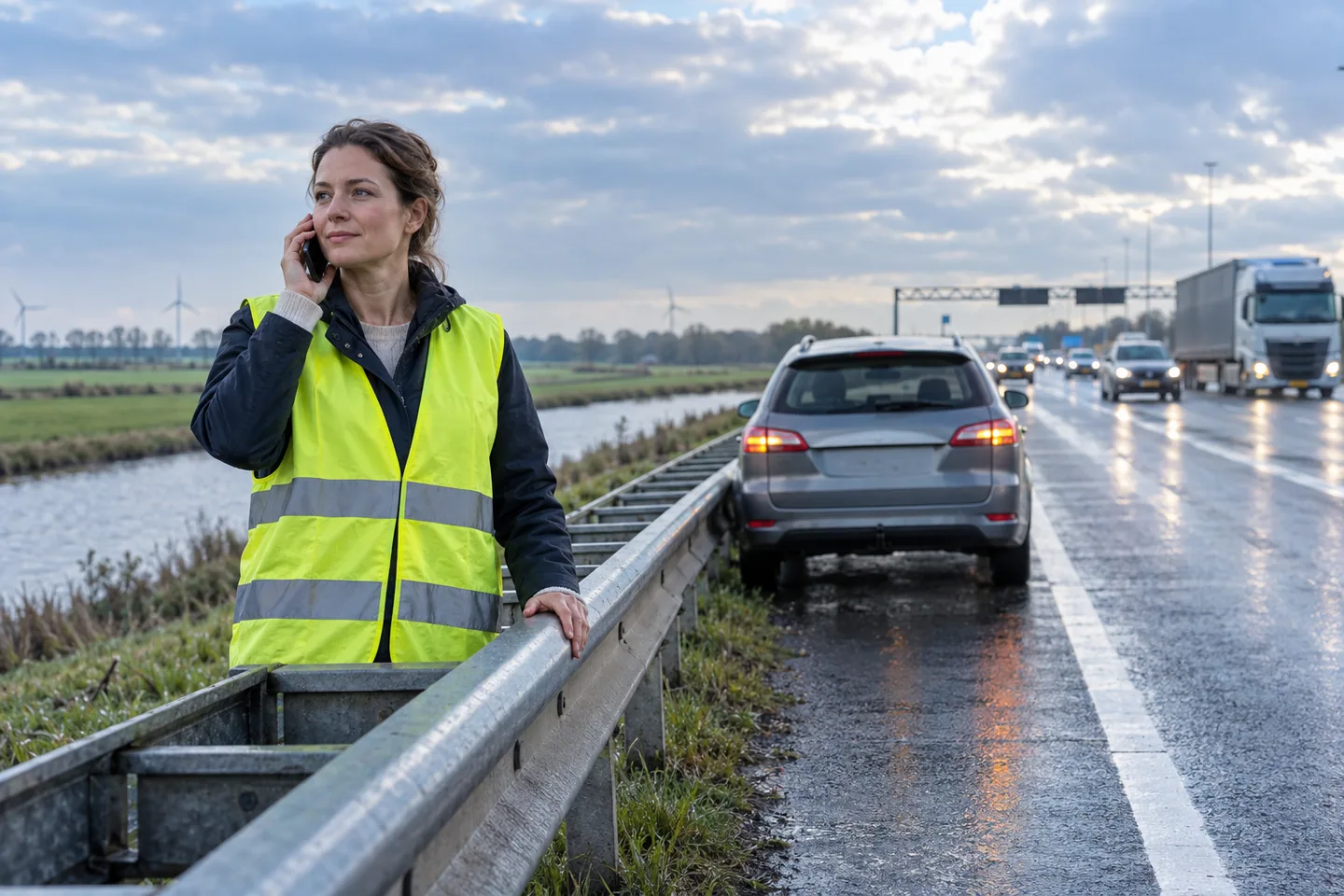
Move out of live traffic when possible, make the vehicle visible and place people in the safest available location.
Ongeval
Prevent further danger, assess injuries, alert emergency services when needed and exchange required information.
Voorrangsvoertuigen
Create space calmly when emergency vehicles use the required signals; never make a panicked or illegal move.
Guidance
Keep steering, braking and observation deliberate; avoid a reflex that creates another collision.
If possible, reach a safe location outside the path of moving traffic.
Move occupants to the safest available place without crossing live lanes unnecessarily.
Use hazard lights and other appropriate warnings without placing yourself at risk.
Contact emergency or roadside assistance and describe location, injuries and continuing danger clearly.
The exact action changes with the scene; the priority stays consistent: people, immediate danger, warning, help.
Vocabulary
Noodstop
Emergency stop
Maximum controlled braking in response to immediate danger.
Pechstrook
Emergency lane
Not a normal travel or stopping lane.
Alarmlichten
Hazard lights
Warn others of an abnormal stationary or dangerous situation.
Slip
Skid
A loss of tyre grip that demands smooth corrective input.
Ongeval
Collision or accident
Secure the scene and assess people before property.
Voorrangsvoertuig
Priority vehicle
An emergency vehicle using the legally required signals.
Warning
Why it's wrong: Live traffic creates the main danger; move behind a barrier or to the safest available place.
Why it's wrong: An instinctive lane change can turn one hazard into a larger collision.
Why it's wrong: Hazard lights warn of danger; they do not make an unsafe or illegal stop safe.
Why it's wrong: Injuries and continuing traffic danger come before property.
Scenario
Scenario 01
The car slows unexpectedly while traffic continues around you.
Exam takeaway: Exit the traffic stream calmly, then protect people.
Scenario 02
Brake lights fill the lane much sooner than expected.
Exam takeaway: Maximum attention does not mean maximum steering input.
Scenario 03
Blue lights and a siren approach from behind in dense traffic.
Exam takeaway: Make way safely, calmly and predictably.
Quick checkpoint
3 questions, answers revealed only after you submit.
Keep going
Stay current
CBRKlaar explains the rules in plain English. For the current legal text and government guidance, use these primary sources.
Answers
When it is safe to do so, occupants should move away from live traffic to the safest available place, such as behind a barrier.
No. They warn others; they do not remove the danger or change traffic law.
Give the location, direction of travel, people involved, injuries and any continuing hazard as clearly as possible.
Use the same order every time: control, safe location, people, warning, help.
You've learned the rules. Now test them in real CBR-style scenarios.